
Site managers earn an average advertised base salary of £46,896 a year in the UK, according to Indeed’s Site Manager job-title data, updated on 2 November 2026. The title includes roles outside construction, so compare the responsibilities as well as the pay.[1]
Start with the city comparison below, then explore pay by experience and contract day rates. The official construction earnings evidence covers managers and directors, so it is presented separately.
On this page
- About these figures
- Site manager salaries in London and other UK cities
- Assistant, site manager and senior site manager salaries
- Site manager, site supervisor and contracts manager pay
- Contract site manager day rates
- Does SMSTS increase a site manager’s salary?
- How to compare two site-manager offers
- What official construction-management earnings show
- How construction-management pay has changed
- Frequently asked questions
- UK site manager salary benchmarks
- Sources and methodology
- Download the data
- Sources
Site manager salaries in London and other UK cities
Search a location or sort by pay. These Indeed averages use the broad Site Manager title, including roles outside construction. Compare the sample size and source date alongside the figure.
Compare 39 locations. City data reviewed monthly; last checked . Each source’s own update date appears in the table.
39 locations shown, sorted by location.
| City or town | Annual average | Salaries reported | Source updated | Checked | Source |
|---|---|---|---|---|---|
| Aberdeen | £47,501 | 32 | [1] | ||
| Belfast | £49,626 | 71 | [1] | ||
| Birmingham | £44,846 | 192 | [1] | ||
| Bradford | £41,643 | 31 | [1] | ||
| Brighton | £82,707 | 88 | [1] | ||
| Bristol | £47,405 | 247 | [1] | ||
| Cambridge | £50,227 | 114 | [1] | ||
| Cardiff | £48,811 | 73 | [1] | ||
| Coventry | £83,288 | 64 | [1] | ||
| Derby | £43,757 | 68 | [1] | ||
| Dundee | £53,169 | 13Small sample | [1] | ||
| Edinburgh | £47,453 | 70 | [1] | ||
| Exeter | £48,472 | 89 | [1] | ||
| Glasgow | £49,459 | 73 | [1] | ||
| Inverness | £49,350 | 21Small sample | [1] | ||
| Kingston upon Hull | £48,802 | 34 | [1] | ||
| Leeds | £48,936 | 176 | [1] | ||
| Leicester | £48,013 | 112 | [1] | ||
| Liverpool | £40,759 | 101 | [1] | ||
| London | £51,235 | 1k | [1] | ||
| Manchester | £45,334 | 297 | [1] | ||
| Middlesbrough | £50,915 | 23Small sample | [1] | ||
| Newcastle upon Tyne | £48,249 | 81 | [1] | ||
| Newport | £51,823 | 44 | [1] | ||
| Norwich | £50,456 | 73 | [1] | ||
| Nottingham | £44,592 | 144 | [1] | ||
| Oxford | £49,962 | 103 | [1] | ||
| Peterborough | £51,889 | 45 | [1] | ||
| Plymouth | £50,222 | 47 | [1] | ||
| Portsmouth | £50,706 | 45 | [1] | ||
| Preston | £44,816 | 53 | [1] | ||
| Reading | £51,435 | 73 | [1] | ||
| Sheffield | £47,260 | 100 | [1] | ||
| Southampton | £43,452 | 81 | [1] | ||
| Stoke-on-Trent | £86,688 | 34 | [1] | ||
| Sunderland | £84,949 | 25Small sample | [1] | ||
| Swansea | £92,034 | 12Small sample | [1] | ||
| Wolverhampton | £45,553 | 58 | [1] | ||
| York | £45,849 | 65 | [1] |
No matching location. Try another name or reset the search.
“Small sample” means fewer than 30 salaries reported. This is our flag for reader context, not a statistical quality rating supplied by Indeed. A count shown with “k”, such as “1k”, is rounded by the publisher.
View a comparison of six cities
Scroll horizontally to view the full chart on a small screen.
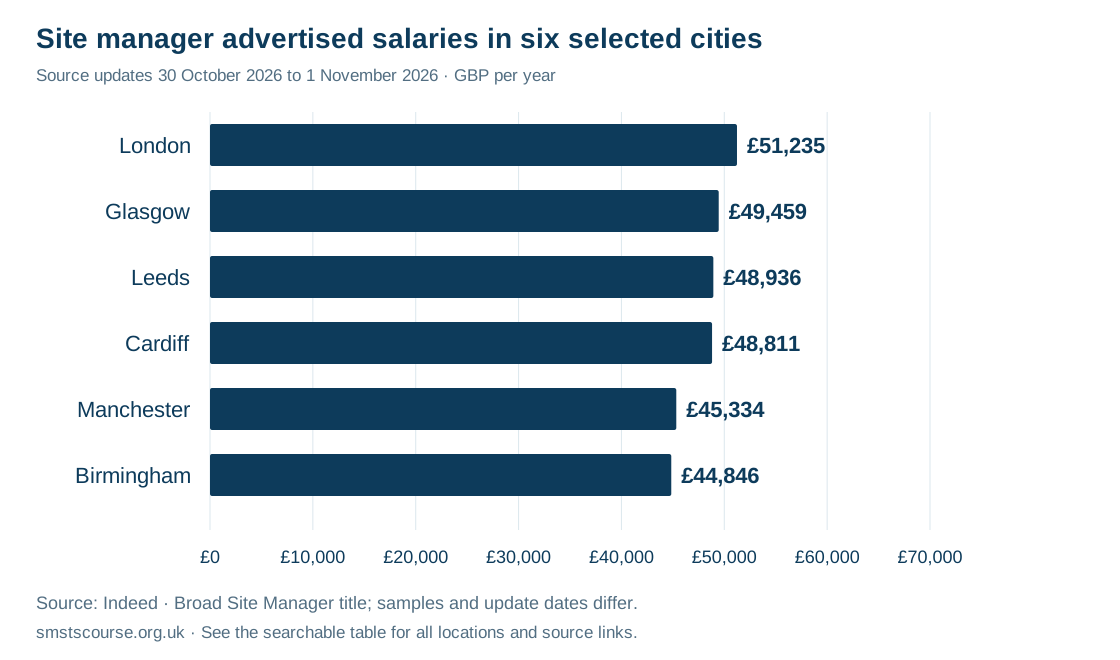
Indeed average base salaries for the broad Site Manager title, not construction-only. Six selected cities for a compact comparison; the searchable table covers 39 locations. Samples and source dates differ. No location premium inferred.
Every row uses a city-level Site Manager page; assistant, senior and supervisor titles are not combined. Some averages are much higher than others, but the underlying vacancy mix is not available to audit. These figures do not establish a premium for doing the same construction job in a different place.
The optional chart shows six selected cities, not a highest-paying-city ranking. No city averages have been combined into a synthetic national figure. Compare the different salary sources.
Assistant, site manager and senior site manager salaries
For construction-specific career guidance, CITB’s Go Construct puts newly trained site managers at around £33,000, with experienced managers able to earn up to about £84,000. Its figures draw on multiple industry sources, rather than a disclosed representative salary survey. Go Construct site manager profile [2].
The National Careers Service gives a different guide: £27,000 for starters to £65,000 for experienced construction managers, listing site manager as an alternative title. These endpoints are guidance for career planning, not national percentiles or a guarantee of an offer. They are more directly about construction than the broad-title city averages above, but the sources cannot be averaged into a single pay scale. National Careers Service construction manager profile [3].
Examples of advertised construction salaries
There is no single, consistently defined national pay scale for these three titles in the sources reviewed. To make the differences tangible, the table below uses three permanent construction vacancies advertised by Hays in 2026. They show what particular employers offered for particular responsibilities. They are examples, not a representative salary survey.
| Role and location | Advertised annual salary | Responsibility and package |
|---|---|---|
| Assistant site manager, Derby [4] | £45,000–£50,000 | Supporting delivery of new-build and refurbishment work. £5,000 car allowance or company car, plus bonus and benefits. Advertised 14 October 2026. |
| Site manager, West London [4] | £55,000 | Private residential refurbishment, including hands-on work and management of smaller projects. Advertised 28 September 2026. |
| Senior site manager, Slough [4] | £68,000–£75,000 | Leading delivery of a £10 million care-home project, with car allowance and bonus. Advertised 19 August 2026. |
The examples differ in geography, project size, employer and work type as well as seniority. Subtracting one salary from another would not isolate the value of a promotion. An assistant role on a major project may overlap with a manager role on a smaller scheme, so compare the actual scope of the job before using its title as a pay benchmark.
What to compare at each level
For an assistant position, look at how much responsibility you hold independently and the support available from the manager. For a site-manager position, establish whether you own the whole site, a work package or several small projects. For a senior position, check the programme, team, budget and handover responsibilities. Those distinctions make a salary comparison more useful than treating years of experience as a complete explanation.
Keep the base salary separate from the package. In the Derby example, the advertised car allowance is additional to salary. A company car is an alternative, rather than another £5,000 to add automatically. A discretionary bonus also should not be counted as guaranteed earnings.[4]
Site manager, site supervisor and contracts manager pay
Job titles overlap, but the responsibilities need not. The National Careers Service describes construction managers as organising projects, site supervisors as checking contractor work against quality and safety standards, and contracts managers as overseeing contractual requirements. Its guidance ranges overlap substantially. Construction manager [3]; site supervisor [3]; contracts manager [3].
| Role | Starter guidance | Experienced guidance |
|---|---|---|
| Construction manager / site manager [3] | £27,000 | £65,000 |
| Construction site supervisor [3] | £30,000 | £60,000 |
| Construction contracts manager [3] | £30,000 | £70,000 |
The National Careers Service estimates ranges using sources such as ONS data, industry bodies and live vacancies, and says they should be treated as guidance. The ranges do not establish a fixed pay increment for moving between these roles.[3]
Contract site manager day rates
Specialist recruiter Astute People reports contract site-manager rates around £450 a day, with a placement range of £280–£600, in its 28 October 2026 market note. Its permanent-placement median is £60,000. The data cover the UK and Ireland and focus on energy, renewables and infrastructure. No sample size or fieldwork period is disclosed, so these are specialist-market indicators rather than a UK-wide construction average.[5]
Why a day rate is not an annual salary
A contract rate tells you the amount attached to a billable day. It does not tell you how many days you will work in a year, what expenses you will cover or what paid leave and other benefits are included. The payment arrangement also matters. Before comparing offers, establish whether the quoted amount is the worker’s pay, a company invoice rate or an agency assignment rate.
The following calculation shows the effect of different numbers of billable days. It is an illustration, not observed earnings data, a forecast of available work or a take-home-pay estimate.
| Example day rate | 180 days | 210 days | 230 days |
|---|---|---|---|
| £300 | £54,000 | £63,000 | £69,000 |
| £350 | £63,000 | £73,500 | £80,500 |
| £450 | £81,000 | £94,500 | £103,500 |
For example, £350 multiplied by 210 billable days produces £73,500 before any deductions or business costs. Calling that a £73,500 salary would hide the assumptions. When assessing the offer, compare guaranteed days, cancellation terms, travel and accommodation, hours per day and the cost of gaps between projects.
Does SMSTS increase a site manager’s salary?
To put pay in the wider recruitment context, see our construction skills shortage statistics. They distinguish current vacancies from the additional workers forecast to be needed through 2030.
The evidence reviewed does not establish a reliable salary premium caused by holding SMSTS. Job adverts can show that training is relevant to an employer’s requirements, but they cannot separate the effect of training from experience, location, sector or responsibility.
CITB describes SMSTS as a five-day course for site managers and people preparing for that responsibility, covering management of health, safety and environmental matters. The Derby assistant-manager advert accepts SMSTS, SSSTS or an equivalent site-management qualification; the West London advert asks for SMSTS or SSSTS alongside other requirements. That supports its relevance to employment, not a promise of a particular pay rise. CITB SMSTS scheme rules [6]; Hays Derby vacancy [4]; Hays West London vacancy [4].
If you are planning your next step, check the qualifications required by the roles you want and compare them with your current responsibilities and experience. You can explore SMSTS course options as part of that development plan.
How to compare two site-manager offers
Start with the guaranteed base salary, then put the rest of the offer beside it. A higher annual figure can come with a longer working week, substantial travel or a different level of responsibility. Keeping those terms visible makes it easier to decide whether a move improves the whole job, rather than only the headline amount.
- Pay: record base salary, guaranteed allowances and the conditions attached to bonuses separately.
- Time: compare contracted hours, weekend expectations, travel and whether overtime is paid.
- Costs: establish who pays for the vehicle, fuel, parking, accommodation and professional development.
- Responsibility: compare the project, team, programme, reporting line and support available.
- Continuity: check the employment or contract term and what happens when the current project finishes.
For negotiations, collect recent vacancies with comparable responsibilities in your area and keep their dates. Present them alongside evidence of the projects you have delivered and the responsibilities you can take on. A general national average is a useful orientation point; a closely matched role is usually the more useful comparison for a specific offer.
What official construction-management earnings show
The 2026 Annual Survey of Hours and Earnings reports a median of £59,993.60 for full-time employees in “Production managers and directors in construction”, occupation code 1122. The mean is higher, at £64,789.50. The median is the middle of the earnings distribution; the mean can be pulled upwards by higher earners. This is a construction-specific benchmark, but it includes directors and is broader than one site-manager job title.[7]
Scroll horizontally to view the full chart on a small screen.
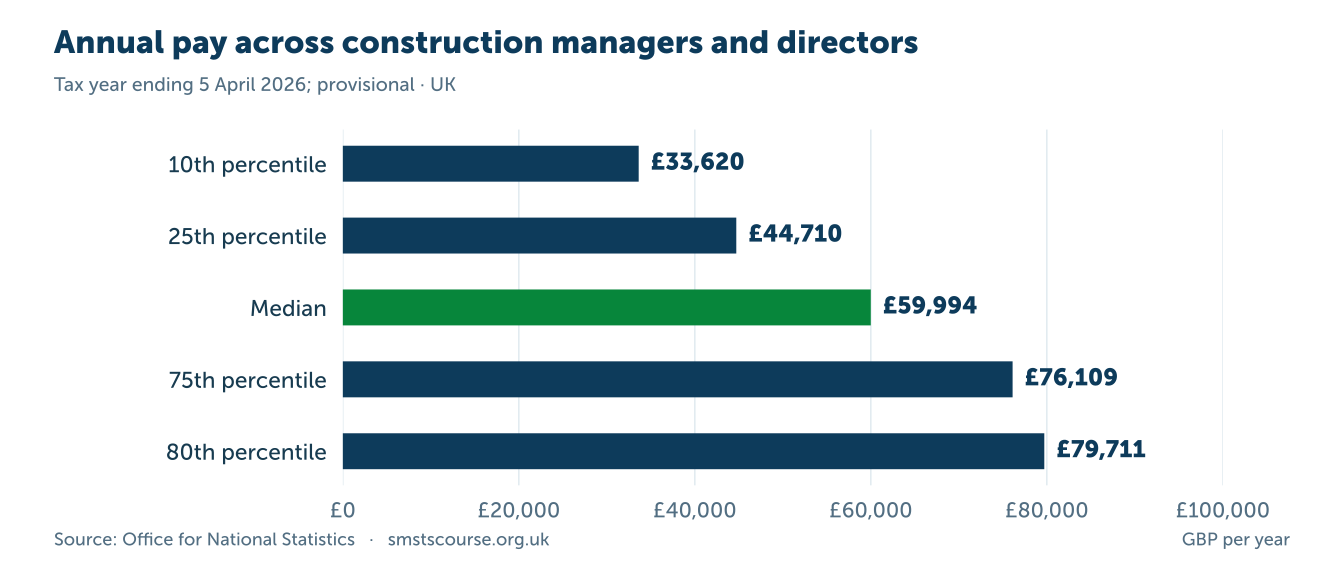
ONS SOC 2020 code 1122, full-time employees. Broader than the site-manager job title; includes directors. Percentiles are positions in the distribution, not experience levels. 90th percentile suppressed.
View the figures behind this chart
| Position in the pay distribution | Annual pay |
|---|---|
| 10th percentile | £33,620 |
| 25th percentile | £44,710 |
| Median: 50th percentile | £59,994 |
| 75th percentile | £76,109 |
| 80th percentile | £79,711 |
[7]. Rounded to the nearest pound. The 90th percentile is suppressed in the source, so it is not estimated here.
The middle half of this occupation’s earnings lies between approximately £44,710 and £76,109. That is a description of a distribution, not a salary ladder: the lower quartile does not mean “assistant site manager”, and the upper quartile does not mean “senior site manager”. Different locations, responsibilities and working arrangements are represented within the same occupation.
The annual measure relates to the tax year ending 5 April 2026. It is not the annualised value of one week in November. The survey’s annual-pay coverage is limited to adult-rate employees who had been in the same job for more than a year, and excludes self-employed earnings. ONS annual-pay reference-period guidance [7]; ASHE workbook coverage notes [7].
How construction-management pay has changed
For the same full-time occupation group, median gross annual earnings rose from £53,497 in the 2024 revised data to £55,932 in 2025 and £59,994 in the provisional 2026 data. ONS reports a 7.3% increase in the 2026 median from the previous year.[7]
Scroll horizontally to view the full chart on a small screen.
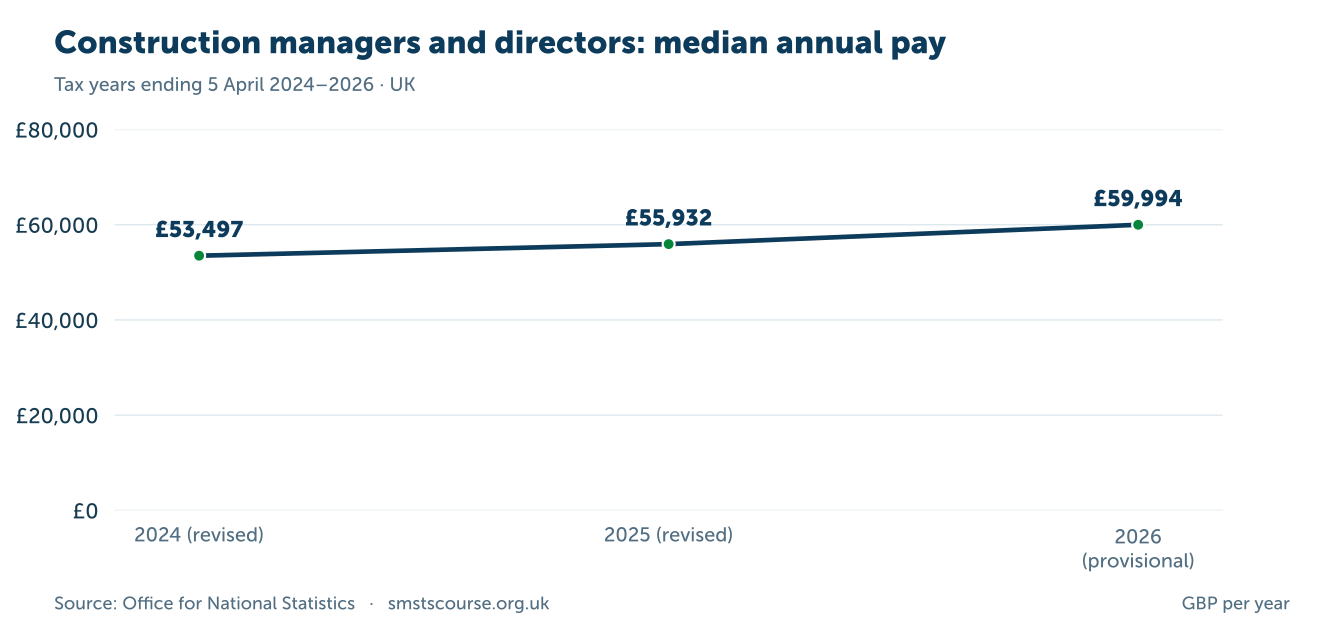
Full-time employees, SOC 2020 code 1122. 2024 and 2025 revised; 2026 provisional. Nominal pay, not adjusted for inflation. Changes can reflect workforce composition.
View the figures behind this chart
| Tax year ending 5 April | Median earnings | Data status |
|---|---|---|
| 2024 | £53,497 | Revised |
| 2025 | £55,932 | Revised |
| 2026 | £59,994 | Provisional |
This is a change in the measured median, not evidence that every manager received the same pay rise. The mix of jobs and workers can change between years. These figures also use cash amounts: they have not been adjusted for inflation, so the chart does not show growth in purchasing power.
Frequently asked questions
What is the average site manager salary in the UK?
Indeed’s advertised-salary benchmark is £46,896 a year, updated 2 November 2026. It covers the broad site-manager title. For construction-only context, use the career guidance and official occupation data above alongside relevant local vacancies.[1]
Can a construction site manager earn £70,000 or more?
Yes, some advertised roles reach that level. The Slough senior-site-manager vacancy offers £68,000–£75,000 plus a car allowance and bonus. It involves leading a specific project, so it is evidence of an available offer rather than a national average or guaranteed career outcome.[4]
How much does a newly trained site manager earn?
Go Construct gives £33,000 as a possible starting point for a newly trained site manager. Its guidance is based on multiple industry sources and varies with the role and employer. Newly trained managers, trainee assistants and experienced people taking their first management title are not necessarily equivalent jobs.[2]
Are site-manager day rates better than permanent salaries?
A higher daily figure does not answer the question on its own. Compare the actual payment basis, expected billable days, hours, expenses and benefits. The contract-revenue examples above show the arithmetic before costs and deductions; they are not permanent-salary equivalents.
Why do salary websites give different answers?
They can measure different things: an average of advertised pay, an employee earnings survey, a recruiter’s placements or a career guidance range. Their job definitions, locations, dates and treatment of benefits can also differ. Check those details before choosing a figure to quote.
UK site manager salary benchmarks
| Source | Figure | What it describes | Date or period |
|---|---|---|---|
| [1] | £46,896 average base salary | UK job postings using the site-manager title; not construction-only | Updated 2 November 2026; previous 36 months |
| National Careers Service [3] | £27,000–£65,000 | Construction-manager career guidance, starter to experienced; includes site manager as an alternative title | Checked 11 November 2026 |
| CITB Go Construct [2] | From £33,000; up to approximately £84,000 | Newly trained to experienced site-manager guidance, compiled from industry sources | Checked 11 November 2026 |
| ONS ASHE [7] | £59,994 median gross annual pay | Full-time employees in construction production management and directorships, SOC 1122 | Tax year ending 5 April 2026; provisional |
Use the job-board figure to understand the broad advertised market. Use construction-specific guidance to explore the possible career span. Use the official occupation data to understand the distribution of employee earnings in a defined construction-management group. A salary range is not an average, and its endpoints are not guaranteed starting pay or a maximum you can earn.
Methodology and update process
This reference combines primary publisher data checked on 11 November 2026. We have not collected a new salary survey or calculated a pooled “average of averages”. The source and date sit beside each dataset, and the downloadable data retain the original numerical precision where available.
- ONS: Table 14.7a, Full-Time sheet, SOC 2020 code 1122. The trend uses revised 2024 and 2025 figures and provisional 2026 figures. Annual earnings refer to the tax year ending 5 April. The 2026 median has a coefficient of variation of 3.6% in the companion quality table. This is a survey estimate, not an exact count of every salary.
- Indeed: the UK and individual city pages supply separate snapshots. Counts are retained as displayed, including “1k” and “9.4k”. We do not combine city samples or infer a construction-only subset.
- Career guidance: National Careers Service and Go Construct ranges are presented as their published guidance. No fieldwork year is assigned where the publisher does not provide one.
- Vacancies: the Hays examples are individual advertised offers checked on the research date. They may expire or change and do not prove the salary ultimately accepted.
- Contract rates: Astute People’s figures retain their UK-and-Ireland geography and specialist-sector context. The billable-day table is our own arithmetic illustration.
Sources: ONS ASHE workbooks and quality tables [7]; Indeed methodology and UK snapshot [1]; National Careers Service information sources [3]; Go Construct [2]; Astute People methodology note [5]. Individual vacancy and city sources are linked in their tables.